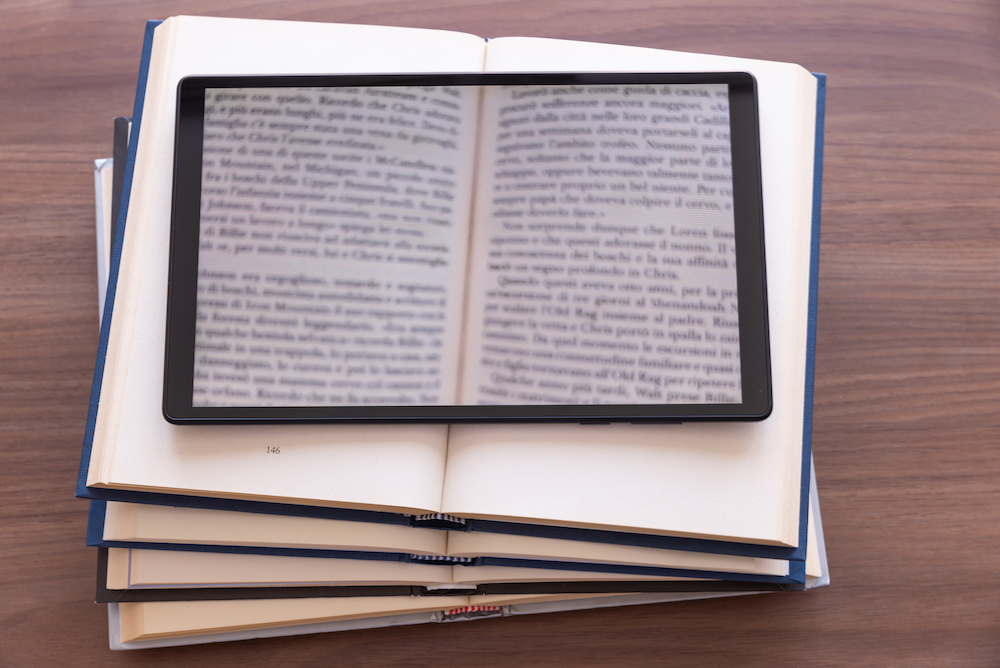
 When deciding between e-books vs. print books many readers grapple with which format best suits their needs. E-books have made a significant mark on the publishing industry, offering convenience and a vast library at your fingertips. However, print books continue to hold their ground, cherished for their tactile experience and collectible value. E-books vs. print books, which should you choose? Dive into the pros and cons of each to determine which format aligns with your reading preferences and lifestyle. Continue reading to take a deep dive on which best suits you!
E-Books vs. Print Books: An Overview
E-books have become a mainstay of the publishing industry. However, predictions of the demise of printed books as a result of the introduction of e-books has not materialized thus far.
At the end of 2023, the industry was up 0.4% over 2022, with total revenues from all categories at $12.6 billion. Overall, print books experienced decreases in revenue, and e-book revenues were up just 0.6%. Let’s take a deeper look at both options and the publishing industry in general.
Recent History of Print Books and E-Books
According to the Association of American Publishers, e-book sales in the U.S. were down 1.5% during the first quarter of 2024 compared to the first three months of 2023, for a total of $255.6 million in revenue. They currently make up 12% of total consumer book sales.
Their share of the market has been inching up over time, but hardcover and paperback books still rule the market, with approximately $3.3 billion and $3.1 billion in sales in 2023, respectively.
The 2020 COVID-19 pandemic was a boon to print publishing. Sales rose 8.2% year over year to a total of 751 million copies, according to Printing Impressions, a publishing industry journal. More leisure time and a need to educate children at home were cited as reasons for the book-buying spree.
2022 brought about several unique trends. First, paperback and hardback revenue both decreased, with hardback coming in 13.6% lower than the year before. E-books also declined, falling 6.5%. It’s interesting to note that digital audio revenue grew 71.7% from 2021 to 2022.
Print Books
Print books have the feel of a book that many readers love. You can hold it, turn the pages, and feel the paper. People who love to read spend a lifetime acquiring books. They may find it wrenching to abandon their shelves of books for a single slab of plastic.
Readers may also compare the quality of illustrations between the two formats and find the print versions superior. The New Annotated Sherlock Holmes can be bought in either hardcover or Kindle versions but readers may find the Kindle version lacking due to the shrunken size of the illustrations and the relative clumsiness of toggling between story text and annotations.
Some readers also experience eye strain using an electronic device instead of a printed book.
E-Books
Books on paper are difficult to carry around, especially hardcovers. If you’re an avid reader and you’re going on a trip, or if you’re just stepping out to a coffee shop, an e-reader or iPad is a far lighter burden than a book or a stack of them.
Important: An e-book might be priced about the same or differently than a printed book. Because of the difference in format, there is an entirely different economic consideration for the good.
There’s also the satisfaction of having an entire library at your fingertips, not to mention an infinite supply just a click away, ready to download instantly.
In addition, e-book buyers have the advantage that the internet gives consumers of any products: No space constraints. Just about everything ever published is available, all the time.
There are some drawbacks. You must recharge an e-reader or any other electronic device. Some screens are not easily readable in sunlight. And, if you are one of the millions who spend the entire workday in front of a computer, reading your favorite author on a computer screen in the evening may not appeal.
Beyond Amazon
Avid e-book readers can stray beyond Amazon or Barnes and Noble and read for free.
The nonprofit Project Gutenberg offers 70,000 free downloadable books, most of them classics well beyond their copyright protection expiration dates. The site Free Classic Books offers just that, in an alphabetized list from Alcott, Louisa M., to Wodehouse, P.G.
Google Books also brags that it has more than 10 million books available to download for free, including textbooks and government documents as well as literary classics.
Special Considerations: The Publishing Business
E-books may omit some of the traditional costs of publishing, but it imposes other costs. Added technology costs involve formatting the e-book so that various electronic devices and browsers can properly download and store the book.
Whether it’s printed or downloaded, a percentage of the e-book price must be paid to online sellers such as Amazon and Barnes & Noble. This can be anywhere from 30% to 70% of the sale price.
The Independent Route
Smaller publishers and independent authors have more leeway with pricing, but they still have many of the same costs. They must give a percentage of their e-book sales to the online distributor, and unless they are graphic designers, they must hire an illustrator to create their cover art.
Most independent authors have to hire someone to convert their books into e-book format. Plus, they still have the marketing and promotional costs that are required to get their books noticed. However, e-books are overall lower in cost to produce, and that is typically reflected in their lower prices compared to print editions.
Click here to continue reading
Original article published on investopedia.com